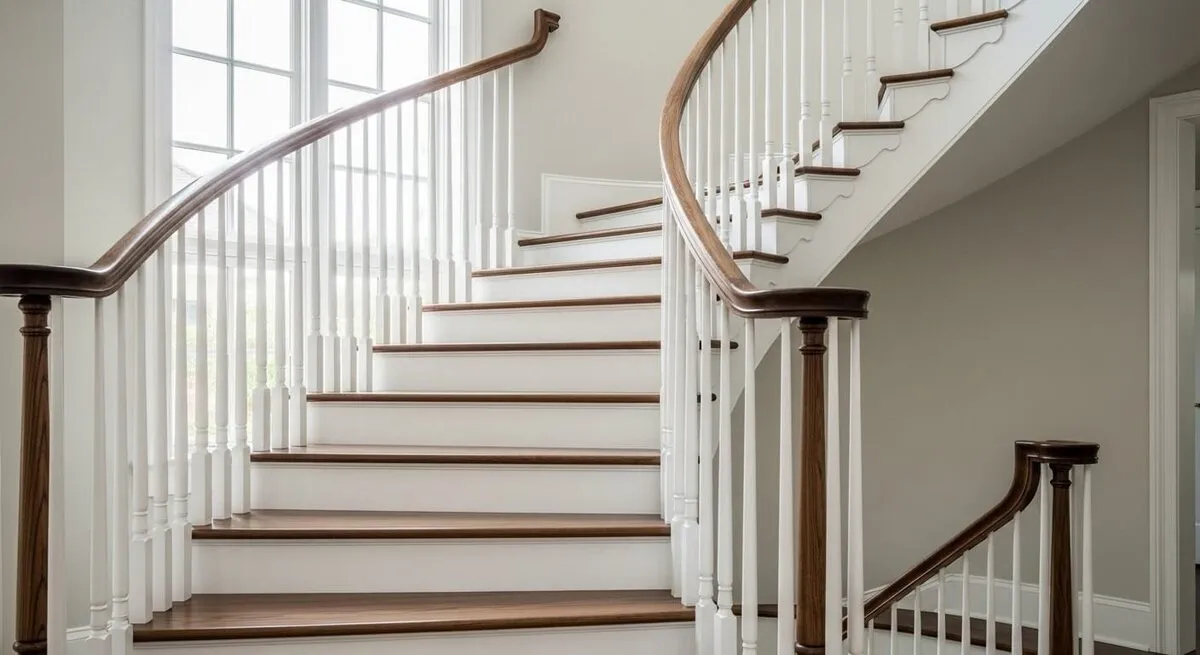
Millwork is any wood product made in a mill or shop and installed in a building. Trim. Molding. Doors. Paneling. Stairs. Built-ins.
The name is literal. It came out of a mill. That’s the whole distinction. Millwork is produced off-site to a specification, then brought in and installed. Framing lumber isn’t millwork. A stud is a stud. But the casing around the window, the base at the floor, the crown at the ceiling, the rail on the stair. All millwork.
What counts as millwork
The category is wider than most people expect:
- Trim and molding: crown, base, casing, chair rail, picture rail, shoe
- Wall treatments: raised and flat panel, wainscoting, board and batten, slat walls
- Ceiling work: coffers, beams, box beams, tongue-and-groove
- Stairs: treads, risers, stringers, handrails, balusters, newels
- Built-ins: libraries, window seats, bookcases, banquettes
- Openings: door and window units, jambs, headers, thresholds
Some shops include cabinetry. Some don’t. That argument is older than anyone still working, and it’s mostly semantics.
Millwork vs. casework vs. cabinetry
These three get used interchangeably on drawings, and they shouldn’t be.
Millwork is custom. It’s made to the drawing, for that building, at that dimension. Nothing about it is modular.
Casework is box construction: standardized cases built to repeatable sizes, then finished and installed. Think base and upper cabinets in a repeatable run.
Cabinetry is the finished product either method produces. It describes the thing, not how the thing got made.
The practical difference is tolerance. Casework works to a catalog. Millwork works to the field measurement. That matters, because no wall in a real building is plumb, square, and true all at once.
Stock vs. custom
Stock millwork comes off a shelf in a handful of profiles. It’s fine when the profile happens to fit and nothing has to match anything.
Custom millwork gets milled for the job. That’s the answer when:
- The profile has to match existing work: an addition, a restoration, a room that has to disappear into the rest of the house
- The species is specified and stock doesn’t come in it
- The scale is wrong. A 3¼” colonial base under a 12-foot ceiling looks like a mistake, because it is one
- The detail doesn’t exist in a catalog
Profile matching is its own skill. We grind the knives to the profile and run it, so new work reads as original. That’s the difference between a repair that shows and one that doesn’t.
What separates good millwork
Four things, and price isn’t one of them.
The profile is right for the room. Scale is the first thing the eye reads and the last thing anyone thinks about. Ceiling height, room proportion, and the architecture’s period all set what the molding should be.
The species is right for the climate. This is Florida. Wood moves with humidity, and a species that behaves in a dry climate can telegraph every seasonal swing here. Selection and acclimation are not optional steps.
The joinery is right. Coped inside corners instead of mitered ones. Scarf joints on long runs. Returns that close properly. These are the details that stay tight after the first summer.
The finish is right. Grain, fill, sealer, topcoat, and the finish schedule matched to where the piece lives. Finishing is not the last 5% of the job. It’s what everyone actually sees.
Who specifies millwork
Mostly not homeowners. Millwork gets specified by the people building the project: general contractors, custom builders, architects, and interior designers working from a drawing set and a millwork schedule.
That’s who we build for. The work runs through molding and millwork packages and architectural woodwork: staircases, beams, built-ins, and whole-home trim programs.
The short version
Millwork is the wood that makes a building feel finished. It’s milled to a drawing, matched to the architecture, and installed to the field. Not pulled off a shelf and hoped for.
If you can draw it, we’ll build it. Any species. Any lumber. If it exists, we’ll get it.
Request a quote and send the drawings.